 Dr. Amy Bakelaar
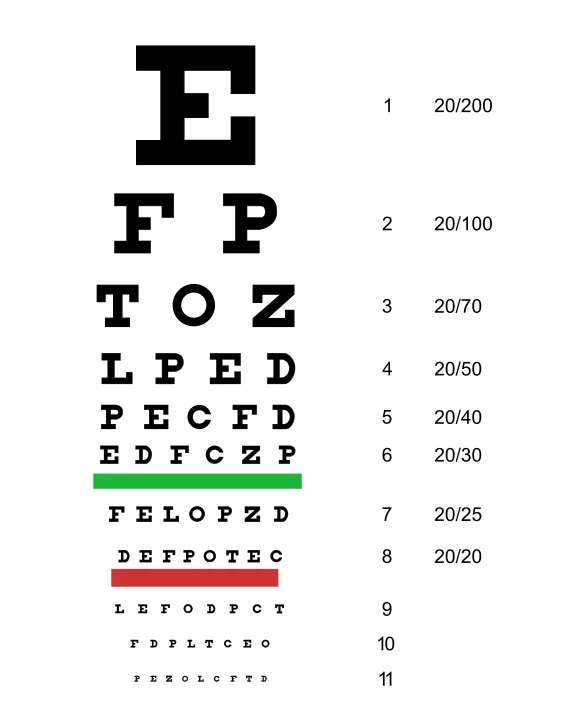
Most people think 20/20 vision represents normal or even perfect vision. However, that’s not quite the whole story! We are all familiar with the eye chart that uses high contrast letters which get smaller near the bottom of the chart, but do we know what it actually means?
Simply put, having 20/20 vision is being able to see a certain letter size at a certain distance. So, if you see a smaller size of letter at that same distance, you have better than 20/20 vision. You might even have 20/15 or 20/10 which is really, really good vision. Accordingly, visual acuity measures the ability to distinguish object size and shape at a given distance.
To use a real world situation: A patient with 20/15 vision can see at 20 feet what the patient with no prescription or ocular health issues will see at 15 feet. And similarly, a person with 20/50 vision will see at 20 feet what the healthy, non-prescription patient will see at 50 feet.
Want to get technical and use high school trigonometry? Mr. Snellen (the guy who came up with the chart) defined the 20/20 standard letter size as “the distance in meters (or feet) at which the letter subtends 5 min of arc”. It is easily recognized by someone who has no prescription and has healthy eyes.
Why are eyes examined at 20 feet?
This is considered “optical infinity” where the eye’s focus is fully relaxed. The metric system uses a 6 meter distance, thus the equivalent of 20/20 vision is 6/6. Most eye exam rooms are not 20 feet long so your eye doctor “fakes” it by adjusting the size or by using mirrors.
Can everyone have 20/20 vision?
If you have healthy eyes and no prescription, you will likely have 20/20 vision without glasses. If not, your optometrist can often find a prescription that brings you to 20/20 vision or better. Some people are not capable of having 20/20 vision despite the proper prescription. In these cases, they may have ocular health issues or neurological problems that interfere with their vision which may require treatment or medical management.